Watch out, it’s October …

No-one seems to understand why, but this time of year is often tumultuous. (Particularly in the financial world. 1929. 1987. 2008.) This year is looking pretty interesting too.

So called “geo-political risk” has risen sharply.

Gaza and Ukraine have settled down for now. Lots of fighting, MH17 shot down, many deaths, lots of destruction, but nothing resolved. These trouble spots will surely flare again, because if you go to the root causes (who should live where in the Jordan Valley, and NATO’s relentless advance to Russia’s doorstep), nothing’s changed.

Attention has now turned to Iraq and Syria. Looks to me like the current tactics and behaviour of the West has about zero chance of resolving anything, and a good chance of making things a lot worse. The IS warriors look to be a nasty bunch, but really no worse than an endless list of ugly groups and regimes. (Who remembers Pol Pot or Idi Amin, just for example?). Bombs will not resolve centuries old enmities, or productively occupy idle young men.

In Hong Kong, the predominantly young (… it’s always the young ones!) have come out bravely and in large numbers to protest for what appears to be a quite small step in their governance. Despite the current lull, a long, on-going, serious challenge for the mandarins in Beijing lies ahead: how to govern a youthful, educated, connected, and rising Chinese middle class?

The list of failed states seems to increase by the month. Libya. Next a few in west Africa?

And, the ebola virus has now escaped west Africa to the US and Europe. Back in Sierra Leone, 121 died in one day this week. This could get really nasty.

Economic performance has turned down just about everywhere …

President Obama is out on the stump for the mid-term elections coming next month, arguing that US economy is recovering. He’s quoting all sorts of numbers about new jobs, and crowing because unemployment has dropped below 6%.

Poor guy, he’s tried really hard, but it’s a delusion.

We all know that economies must under-perform if households don’t/can’t spend. US households are still up their necks in debt (student loans, car loans, mortgages, credit cards). The US Bureau of Census has just announced that real household income has now fallen back to where it was 20 years ago. And the percentage of the population in the US workforce is not even close to recovering the ground lost in 2008 …
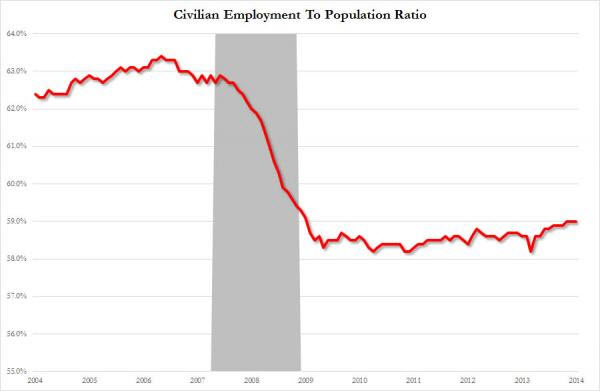
employment to population


In Europe, the motor is sputtering just at the time when things should be getting to work. All the major economies, Germany, France and Italy are in recession, or all but. Germany is the manufacturing heartland, but factory orders in August fell 5.7% … oops.

Over in Japan things are going from bad to worse. Abenomics has failed. The economy is going backward again, and fast: down 7% in the second quarter and probably barely positive in the third quarter just finished.

It’s always hard to work out what’s really going on in China, but except for the odd spot of (probably made up) positive news, it’s all looks bad. China’s recent growth has been built on a massive bubble of debt used to finance infrastructure and housing. Now the housing bubble is deflating. The iron ore price has tanked. Worse is coming.

Australia is muddling along. But the miners are taking a battering, the Government is squeezing and unemployment rising.

… but the party is rolling on in the financial markets … or is it?

Wall Street has retreated a little from it’s top, but is still very high by any standard. It has been propelled by freshly printed money (about $3.5 trillion); huge buybacks of shares (dividends and share buybacks have recently been consuming more than 90% of corporate cash – so not much productive investment going on there); and frothy valuations of tech related stocks. One of my favourites is the Facebook purchase of Whats App at $22 billion. Whats App has 500 million subscribers, no advertising, and just the potential to earn $1 per subscriber per year. Value 44+ times revenue? … Hmmm, not sure about that!

October will be interesting …

…and if you got the time check this out
Posted in debt, financial markets, tough times | Tagged , , , , | 1 Comment

Are you scared yet?

Our leaders (of both political hues) seem to be on a mission to make us feel scared. It’s a centuries old political ruse: raise popularity and power by appearing to save the populous from what they are scared of. But first you have to find/create/invent the target.

Think about it. What is the very low, real probability that your standard of life, personally, will be affected by the entry of an ill-intentioned asylum seeker, or a by terrorist attack?

Now compare that with the high probability that you will be affected, one way or another, over the coming few years by one, or perhaps all of: the effects of climate change; the scarcity of cheap fluid energy and fuel; mis-allocations in the use of land and water; the bursting of the gigantic credit bubble that is still blowing up all over the world; the rise of the unemployed, un-engaged, idle, aggravated young (not just in the Middle East, but most recently in Hong Kong … where next?); the inevitable busting of the China boom (Bloomberg has just reported that Q3 land sales in China have fallen almost 50% year on year); falling asset prices (perhaps even your own house).

These are the things that will affect us all. Aren’t these the things our leaders should be focused on?

Posted in politics and leadership | Tagged , , | Leave a comment

Australia’s place in the world

It’s hard to comprehend how fortunate we are to live on this remote island continent, Australia.

  • No-one is inclined to just move in and build “settlements” on our land.
  • No-one can build a tunnel under our border or fire cheap rockets over it.
  • We have absolutely no experience of “different” people living just the other side of a line drawn for reasons only understood by a bunch of now dead, obscure colonialists or politicians.
  • We don’t have to live in the midst of ethnic, religious or cultural enmities that have persisted for centuries.
  • We don’t have tens of thousands of desperate North Africans pouring across a narrow sea, or homeless and destitute children pouring over the fence from Central America.
  • We are a long way from the source of frightening disease.
  • We don’t have to patrol our remote rocky islands with ships and planes or skirmish with neighbours to defend them.
  • We don’t have to live in pollution created by others.
  • We don’t have to rely on others for access to precious fresh water and food.
  • We don’t have millions upon millions of (predominantly young) unemployed, under occupied and resentful citizens.
  • We are the 12th biggest economy in the world, supporting a modest population.

So how should we handle this extraordinary good fortune, while lacking the real understanding that comes from standing in others’ shoes?

Is it right, for instance, to:

  • Drastically reduce foreign aid so we can spend more money on ourselves?
  • Ignore the risks to the planet (particularly many of our Pacific Island neighbours) of changing climate because of our contrary, short term economic self interest?
  • Pick Japan as a better friend than China?
  • Put up a stop sign on the North West Shelf?
  • Put on a sheriff’s badge and throw our weight around in Indonesia or Ukraine?
  • Tell Mr Putin he’s an irresponsible bad guy?
  • Threaten anyone else we unilaterally decide is a bad guy?
  • Try to make the G20 the G19?

Or should we be learners (not preachers), diplomats (not warriors), mediators (not partisans), realists (not idealists)?

Posted in inequality, politics and leadership, why do people do what they do | Tagged , , , | Leave a comment

Bombs away …

Last week the Pakistani air force was bombing it’s own people in the northern province of Wazirstan. Well over 100,000 people fled.

The Iraqi “government” has started bombing its own Sunni people in the north with a few helicopters, and plans to up the ante with some second hand Russian jets. Accuracy probably won’t be great!

The Israeli Government has decided the best way to punish the apparent murderers of three of their citizens is to summarily declare all of Hamas guilty, and rain bombs down on the Gaza strip.

The Syrian government has been bombing it’s own country for several years.

Now the new regime in Ukraine is bombing Ukrainian people in the East of its own country.

Might there be something wrong with this plan??

But then again, in response to the “re-interpretation” of their constitution by the Japanese Diet:

“Australia has welcomed Japan’s announcement to allow it’s military to fight overseas, saying it will enable Japan to further contribute to international peace and stability.” … ABC News 

I must have missed the memo … When did bombs and fighting “contribute to international peace and stability”?

Posted in politics and leadership | Leave a comment

Monetary policy is broken

There’s been a lot in the media recently about ballooning housing prices and debt – and not just in Australia.

The IMF has recently warned that Australia, New Zealand, Canada, the UK and others, face the possibility of major economic disruption because of high house prices, and the debt incurred by households to pay those prices. High house prices flow into the whole cost structure of an economy and make it less competitive with economies with much lower house prices (like the USA).

Debt works when accumulated savings pass through the banking system to borrowers who have a continuing prospect of sufficient future income flow to pay the back the interest and principal on the loan. Debt fails when the future income falls short and repayments can’t be met. The risks are: future income falls short of expectations (like losing a job); interest rates rise; or the principal borrowed in the first place is just too damned high. This last risk is the issue with high Australian house prices.

When debt fails, some one must lose: there’s no avoiding it. Could be a bank, savers, the borrower, or maybe all of them. These losses hurt people badly. If there are lots of them, the economy and even the whole fabric of society can be threatened. (There are plenty of examples of huge debt failures related to housing and debt through history – Japan 1989 for example. Many in 2008 – Spain, Ireland, USA – where it might take a whole generation to recover.)

Managing the money supply and interest rates are the key elements of monetary policy. The theory is that if policy makers (in Australia the Reserve Bank) adjust these, they can stimulate or dampen market activity and borrowing to smooth the bumps in economic activity. Good in theory.

One result is that a key mechanism for boosting or dampening house prices is an adjustment to interest rates (by making it more or less expensive to borrow and hence afford a house). Hence, in Australia, because of our obsession with house ownership, there is an almost manic focus on the next RBA move up or down on interest rates.

But this traditional monetary policy tool is broken.

Before we look at why, let’s look at just how big the debt is.

Australian households owe about $1.8 trillion. 75% of that is housing debt. This is about 1.8 times household disposable income (the flow required to repay the debt). In the USA this ratio is 1.1 and in the UK 1.5. So we are huge borrowers relative to our disposable income. (And the magnitude is about twice all business debt, and huge compared to the much talked about Australian Government debt of only $350 billion.)

So here’s why current monetary policy is broken …

In Australia the RBA sets a cash rate that then becomes a major determinant of market interest rates for all lending – for housing and personal loans and for business.

In an effort to help stimulate business and the economy, the RBA has driven the cash rate to all time lows. At 2.5% there is still scant evidence for this being the sought after stimulus to business. So business argues (selfishly but in some ways with justification) for even lower rates to stimulate the real economy. Retailers and manufacturers are on this theme all the time. But does a percent here or there really change a business decision to invest? It never has for me.

Furthermore, because rates are even lower overseas (near zero), some of the huge volume of hot money that floats around the world, has floated into Australia in search of higher interest earnings on cash. This drives up the $A exchange rate. That, in turn, makes Australian exports less competitive, and causes businesses that compete with imports (like car manufacturing) to struggle. To stem that money flow to drop the exchange rate, interest rates would have to go down.

But … because 2.5% is seen to be very low, and mortgages more “affordable”, households have been piling on new debt and bidding up house prices. So, to cool the housing market interest rates should go up.

Down? Up? The RBA can’t have it both ways, and is caught with a huge policy dilemma.

The solution is to drop interest rates further to stimulate business, and use other tools (lending rules, bank regulations, taxes) to cool the overheated housing market.

Already Singapore, Hong Kong and New Zealand, and probably others have done just this, when faced with similar economic policy issues. This week the Bank of England has joined that club.

The BoE is set to impose a tight limit on banks lending more than 4.5 times the household income available to support a mortgage. That’s pretty tough. Think how that would work here: $560,000 house (typical in my town); 80% mortgage of $450,000; would require reliable household disposable income of $100,000 (not typical in my town).

Hmmm …

In Australia we now have a Parliamentary Committee looking at foreign investment in housing which is only a small part of the problem. Nevertheless they seem to be talking about stamp duties, taxes, and specific restrictions to try to cut off some demand.

Watch for the RBA to move this way too!

Posted in debt, risk | Tagged , | Leave a comment

Propaganda that stokes fear controls the masses

“the only thing we have to fear is … fear itself — nameless, unreasoning, unjustified terror which paralyzes needed efforts to convert retreat into advance” … Franklin D Roosevelt (1933 Inaugural Address)

Fear is created by propaganda. Fear paralyses. Fear controls the masses.

Fear is the principle weapon of the terrorist. It allows small numbers to make large numbers do what they want them to do. Okay, we all “know” that.

Fear is also a weapon of the state. In the extreme, dictators (like Stalin, Pol Pot, the North Korean Kims) use fear to totally control their minions and their people. But even in benign democracies fear controls our behaviour to some degree: we don’t want to get caught drink driving, or evading tax, do we?

So what’s the role for the media in this?

In some countries, state run media is all important (China, North Korea): it’s a tool for ensuring the message aligns with the state’s desire to control the people. In other countries, restrictions and constraints on the media have much the same effect. (The recent trial of Al Jazeera journalists in Egypt is a recent example: woe betide the journalist who supports opposition to the state.)

In countries like these we know that the media delivers state propaganda, or that reports are sanitised so as not to offend the state. We react to the stories accordingly.

But how do we react where the media is “free”? Like in the US or the UK or Australia.

In Australia, we have radio shock jocks like Alan Jones and Andrew Bolt, and “news”papers like the Australian, that unashamedly peddle opinions dressed up as news. It’s designed to create fear: fear of asylum seekers, fear of trade unions, fear of bikie gangs, fear of lefties … fear of the state.

And fear controls. For who and for what? In these cases it is predominantly for the benefit of right wing governments, because they’re more friendly towards the elites they are, or represent. It’s willful, biased propaganda. Some see through it, many don’t.

But these guys are mere amateurs compared with Fox News in the US.

Yesterday my attention was drawn via RT to a rant on Fox by a presenter called Jeanine Pirro. Ever heard of her? No, neither had I …

It was on Iraq. After referring to Iran as the “devil” and ISIS as “savages”, she offers her solution. “… air strikes … bomb them. Bomb them, keep bombing them, bomb them again, … and again.

Straight from the Cheney, Rumsfeld, neo-con playbook! … Sure, that’ll work!

That’s serious propaganda. It’s fear mongering in the extreme.

Of course, Mr Murdoch’s Fox “News” has the reputation of being right of centre, but this rant is something else … see for yourself here … (about 5 mins). Note the none too subtle words “justice” and “judge” appearing on the screen throughout.

And there are people that believe this stuff!! … and so they fear those “dreadful people in the middle east”, every last one of them.

And who benefits? … Certainly not Iraqis, nor Syrians … nor in the end, the average American, who lives in a world surrounded by fear, by 300+ million guns, by the TSA, by police and thousands of SWAT teams increasingly armed with military hardware.

Looks like Eisenhower was right when leaving office he warned about

“… a formidable union of defense contractors and the armed forces … we must guard against the acquisition of unwarranted influence, whether sought or unsought, by the military-industrial complex. The potential for the disastrous rise of misplaced power exists, and will persist.

… but Ike’s warning was not heeded, and we haven’t been on the correct guard.

There’s also an interesting riposte to Pirro from that intriguing celebrity, Russell Brand. Have a look here. Don’t fooled by the long hair, the tattoos and the funny accent: he’s an articulate, deep thinker, tuned in to the young and the underprivileged.

In principle, of course, we should defend Fox’s right to say what they say. But that does place a huge challenge on those that disagree with Fox’s constant violent propaganda. Shouting back, louder, isn’t the answer. The answer must lie in persuading those that decide to put people like Pirro in front of the camera to ponder the wisdom of John F Kennedy:

“Those who make peaceful revolution impossible will make violent revolution inevitable.”

100 years ago today, an act of violence in Sarajevo and the subsequent propaganda, the hubris of the elites, and the failure of diplomacy, plunged Europe and much of the world into tit for tat violence that became World War I. Traces of that legacy are still playing out in Iraq right now …


Posted in inequality, power and democracy | Tagged , , , , | 1 Comment

US GDP downer pushed the market up!

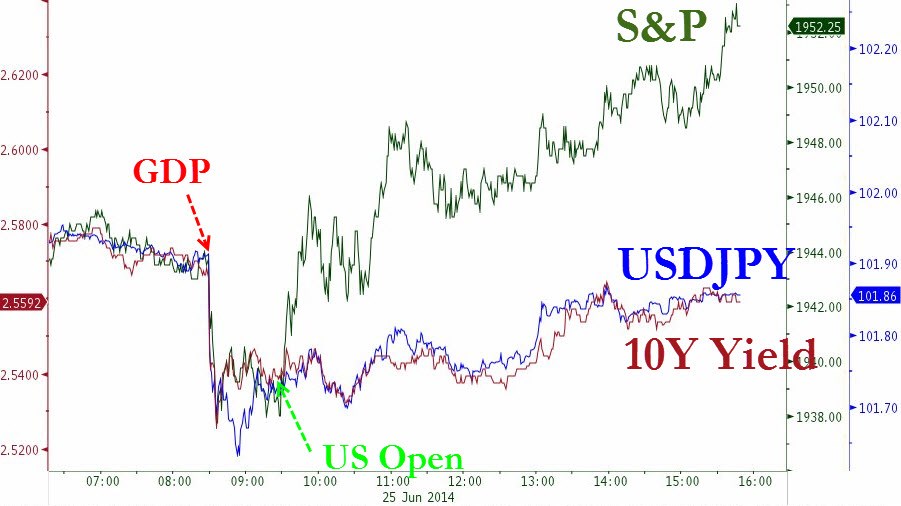
About an hour after my last post, the US Department of Commerce released it’s final revision of data for US GDP for the first quarter of 2014 … a staggering -2.9%.

Bloggers, twitterers and columnists went into overdrive:

“This is the worst non-recessionary quarter of growth in 60 years!!!” … ZeroHedge

“A Recovery in Need of a Recovery … the worst quarter since the last recession ended five years ago” … New York Times

And what did Wall Street do in the face of this shocking economic news, you ask?

It went up! … here’s the S&P 500 for the day. Note the timing of the announcement and the timing of the market open (courtesy of ZeroHedge):

25 june


Why? … because the speculators believe the news will lead to more money being printed by the Fed to feed the already pretty fully blown up bubble stock market.

This is one mighty liquidity bubble … different to the tech bubble of 1999, and the sub-prime mortgage bubble of 2007, but heading towards the same (or worse) catastrophic end.

You know what happens when you just blow and blow and blow into a balloon: first, your cheeks hurt as the back pressure builds, and then …

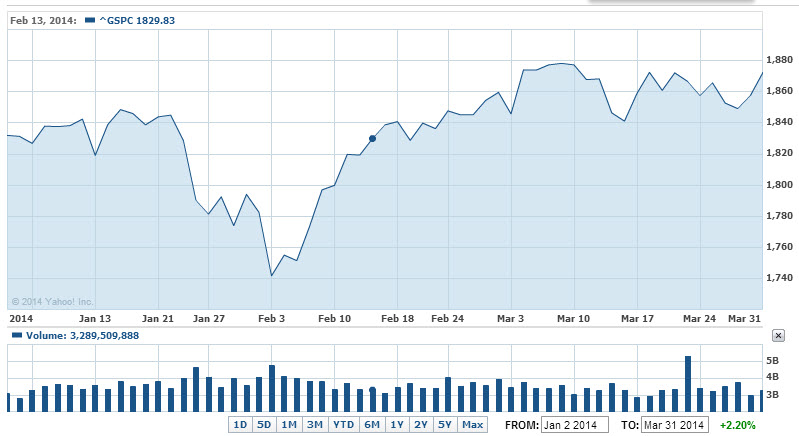
At the beginning of Q1 2014 the consensus forecast growth for the US economy was +3% according to Reuters. (Hmmm … that was a bit of a miss …) And while the US economy was going through this shocking quarter, the S&P did this:

S&P Q1


… not much really … a few nerves in February (when the weather got really bad) … but then quietly pushing on 130 points to be 40 past where it started. And as we saw yesterday, it has since moved on further up to 1950+

Economic fundamentals just are not relevant to the market any more …

… until of course it all comes crashing down, and the “too big to fail” bankers and their ilk set out to socialise their losses by begging for Government bail-outs …

… then we’ll all feel the economic impact, for sure!


Posted in financial markets, risk | Tagged , , , , , | Leave a comment

Approaching a market top?

A weird complacency seems to have settled over Wall Street.

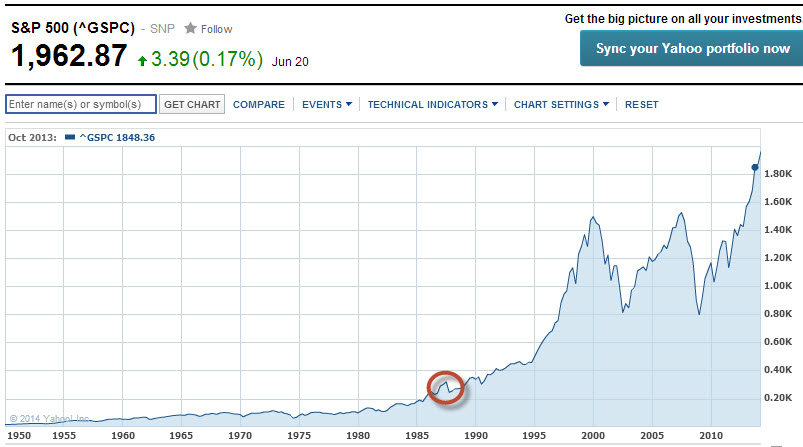
Stock prices are at a record. The S&P 500 broad index, currently at 1950, is remorselessly approaching 2000. It’s been climbing with hardly a pause for breath for more than five years. That’s becoming quite a long stretch. It’s now about 26% above the last major high of 1576 in October 2007, before it got smacked all the way down to 676 in March 2009 by the Global Financial Crisis.

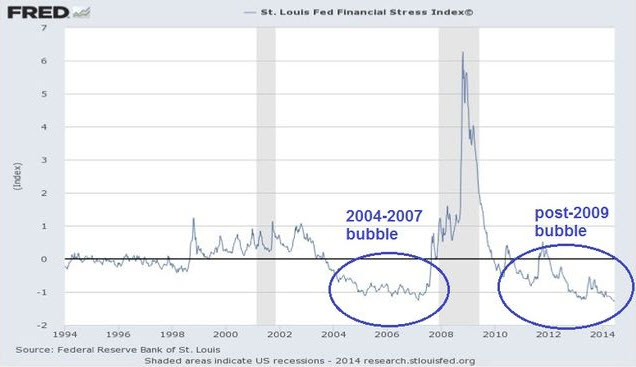
Trading volumes continue to drift lower. Indexes measured by the Federal Reserve of market stress and volatility (shown below) are at generation lows. People are even giving up watching CNBC for market news! It’s an eerie calm:

stress index

However, prices are now such that, on just about every respectable measure of value, the market is well overvalued, and likely near a top:

  • The CAPE Schiller P/E that measures long term earnings performance against prices is at 25 compared to it’s long term median of 16
  • The ratio of total market capitalisation to GDP (Warren Buffett’s favourite yardstick of value) is at 1.27 compared to it’s long term median of 0.65
  • Tobin’s Q ratio, which (for the non financier) represents ratio of market value to the underlying asset replacement value is at 1.09 compared to it’s long term median of 0.70

And just look at this long view of the S&P 500 index. It makes you wonder if the world really has gone crazy (again). That little red circle highlights the October 1987 stock market crash that wreaked considerable havoc at the time. It is one of the things that led Australia towards “the recession we had to have”: (and we haven’t had one since!)

S&P

These indexes, and the doziness in the market, consistently point to the widespread belief that what has been going up since 2009 will just keep going up.

Why? Because the US Federal Reserve continues to hold interest rates near zero and pump virtually free new money into the financial markets. About $3.3 trillion since the GFC. Fed Chair, Janet Yellen, continues to assure the world that things will stay “supportive” for however long it takes. The Fed’s intent/plan is that Wall Street is supposed to push (at least some of) this new money into the real economy to help kick it along. That’s what they say, anyway. But it hasn’t worked out that way.

Instead it has just inflated asset prices off almost the charts. Record stock prices. Strangely high bond prices (because of the freakishly low interest rates). Record corporate merger and acquisition activity (which rarely adds any real value in the economy). Record share buy-backs (raising ultra cheap debt for the corporations, goosing the returns to their shareholders, and enhancing executive bonuses based on share price performance). Record margin lending. And, some completely absurdly valued new listings coming on to the market.

That’s all financial market stuff, mostly benefiting the players in that market.

Wall Street is, of course, still the key global equity capital market. So often does it provide a “lead” to many other markets. So those too have seen the share prices rise above typical and historically fair values. (With the curious exception of China, where despite the fact that China’s economy is supposed to be the saviour of the world economy, the stock market is lower than when the GFC hit. Hard to explain that, really.)

This same behaviour of asset prices is reflected in high end property. In just about every major centre in the world (particularly those where the 1% congregate), property prices have been rising at rates anywhere from 15% to 30% per year.

And even in the fine arts, prices are going crazy. Look at this:

abstract painting


Like it? … Someone does.

They’ve just paid almost $US 26 million for it at Sothebys. Hmmmm …

And then when you look for the signs that these market values are reflective of the health of the real US and world economy, they simply aren’t there.

US GDP fell by about 1.6% in the first quarter of 2014. Real average wages have not risen since the 1960’s, and they’ve certainly done nothing but fall since the GFC. The great US middle class consumer is being crushed: borrowing more and enjoying it less.

Extended monetary stimulus in Japan has dropped the value of the yen, created trade deficits, boosted the stock market, and introduced consumer inflation whilst seeing real wages continue to fall. That’s an epic fail.

In China the stories of debt defaults, missing collateral, and imploding property markets, continue to mount. It’s hard to believe much of the “good” economic “data” coming from there.

And Europe stumbles along with it’s massive unemployment staying high, no economic growth, and now, negative interest rates.

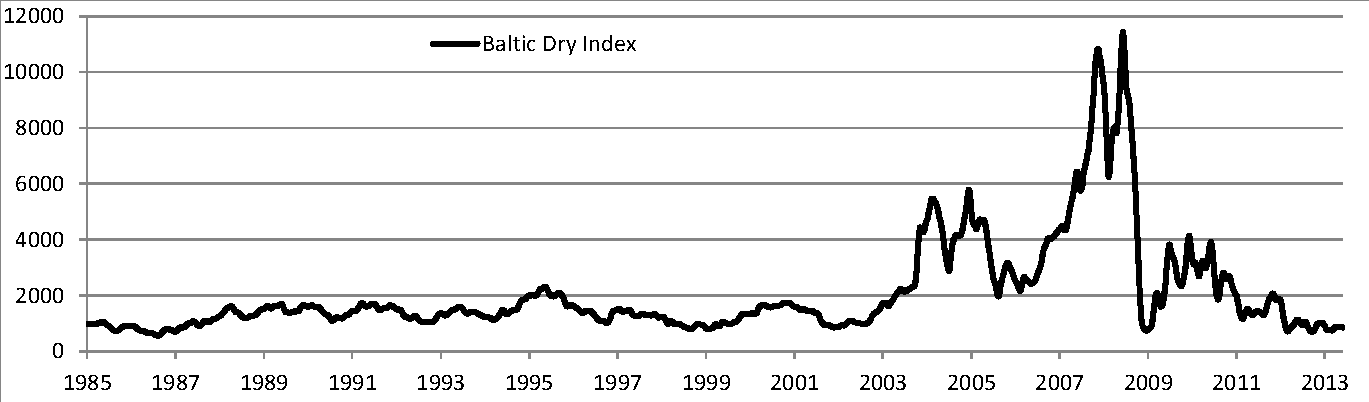
What about world trade? Well, the Baltic Dry Index, a keenly watched daily assessment of the price of moving the major raw materials by sea, and a good indicator of the health of world trade in major dry commodities like iron ore, coal and grains, is having its worst year ever. The Index has slumped to 12-month lows (867) and is showing absolutely no signs whatsoever of the renaissance in global growth that has been heralded.

Baltic dry index

In other words, I find it really hard to find convincing evidence from the major economic engines of the world (USA, Europe, China and Japan) of the justification for the optimistic values on Wall Street and other “following markets”.

Sooner or (maybe not much) later, hard economic reality is going to catch the bankers out.

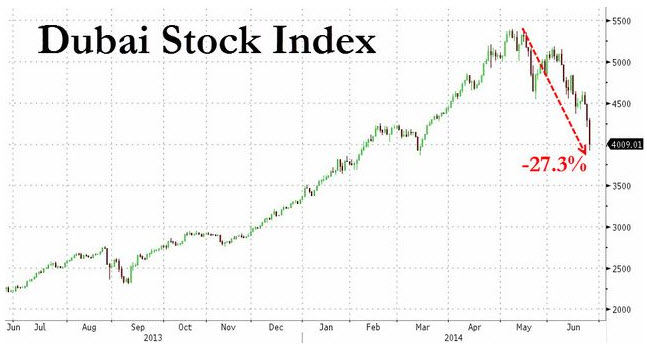
So, with all the above happening, and with the rumbling turmoil very nearby, is Dubai showing the way? The whole Dubai market’s capitalisation is only about half that of Apple, so it’s a minnow.  But that’s a big drop in 6 weeks. Enough to put the scare into other financial markets maybe? …

dubai


Posted in debt, financial markets, risk | Tagged , , , , , , , | 1 Comment

Celebrity insider trader goes to gaol …

Back in 2012 Rajat Gupta was sentenced to 2 years gaol in New York for insider trading. He appealed, of course. But that failed. So last week off he went to a friendly gaol nicknamed Club Fed (where he can have visitors for 6 hours every Friday and all sorts of other comforts). If he’s a good chap, he could be out for Christmas next year.

Never heard of him? … Neither had I until recently, but he’s a big hitter. Former head of a big Russian bank, and former global head of McKinsey & Co, probably the world’s most prestigious strategic consulting firm. A man with a stellar career in business.

Also, one of the .01% with friends in high places.

At his trial, Bill Gates, Kofi Annan (and we all know who they are) and “hundreds” of others gave him glowing character references for his otherwise “exemplary life” and his extensive philanthropy, according to the Wall Street Journal … Nice how the elites look after each other, isn’t it.

So what did Gupta get up to?

He was a director of that pillar of Wall Street, Goldman Sachs. 23 seconds after a Board meeting in 2008 he called a mate with the tip that Warren Buffett of Berkshire Hathaway was about to pump $5 billion into Goldman to help prop it up during the financial crisis. His mate Raj Rajaratnam, head of hedge fund Galleon, made a least a million off that one phone call.

Gupta was also on the Board of Proctor & Gamble, and apparently he told his mate Raj about secret P&G stuff too.

According to the WSJ:

[Gupta’s] tip about Berkshire Hathaway Inc.’s impending investment to shore up Goldman during the crisis was “disgusting in its implications” and “a terrible breach of trust,” said Judge Rakoff before he handed down the sentence. He added: “Others similarly situated to the defendant must…be made to understand that when you get caught, you will go to jail.”

(Great name for a judge, that … Rak off!)

Investigators couldn’t find any evidence that Gupta made any money out of dispensing this insider information to Raj. Gupta claims he didn’t. He says he did it all out of friendship with Raj … Well of course! Isn’t that what friends do?

But this shows (yet again) that you need to be careful choosing your friends. Gupta’s insider information was discovered during investigation of the huge network of trading information sources that Raj Rajaratnam and the Galleon fund used to benefit themselves at substantial cost to others. Raj is now also in gaol for an 11 year stretch (in another Club Fed of course) for many insider trading offences.

Pity the poor Feds. Insider trading is insidious, and I suspect, rife. It’s all too easy (and tempting) for one person A to quietly tell another person B an insider secret and for B to go into the market and buy or sell to profit from that information. And all too easy for A to then get a kick back from B. The perpetrators are always mates and cooperate. The victim is an amorphous, faceless mass of people, not in on the secret, called “the market”: those that trade, oblivious to what’s really going on behind the scenes. This anonymity is the characteristic of the victims that makes it so easy for otherwise “exemplary” people to justify to themselves doing what they do.

Gupta and Raj got caught. I suspect they are a tiny fraction of the perpetrators. Here’s some data from the Wall Street Journal. You be the judge about who’s in front: the insider traders or the Feds pursuing them? And, when they do catch one, does the punishment fit the crime?

Under Manhattan U.S. Attorney Preet Bharara, 72 people have been charged with insider trading since late 2009, and 69 have pleaded guilty or been convicted.

So far, 37 of those people have been sentenced to a total of roughly 68 years in total prison time.

Posted in financial markets, inequality, why do people do what they do | Tagged , , , , | Leave a comment

Historic rivalries, oil and interference … a toxic mix

“There are decades where nothing happens; and there are weeks where decades happen.” … Vladimir Lenin

It feels like we might be in one of those “weeks” …

From this distance the Middle East looks unbelievably complex. Scant few can hope to understand fully what’s going on right now. Fewer still can predict where current events will turn.

But we can be sure of just a few big things, I think.   Continue reading

Posted in power and democracy | Tagged , , , | Leave a comment